EVENT
Polis: The Mental, The Marginal and The Material Life: CUS C HED Conversations (CCC)
Aaram Hall, Subhash Park, Kochi
Mar 21, 2025@5:0 AM
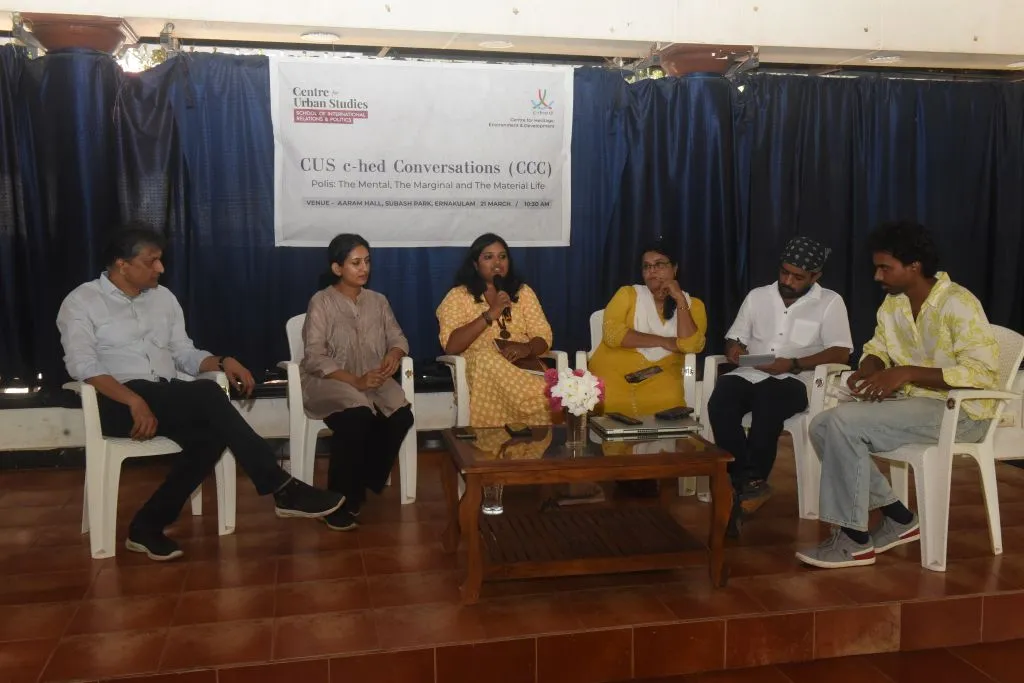
The discussion sought to extrapolate the character of the city beyond the geographical limits of Kochi and foreground three critical dimensions of urban life — the Mental, the Material, and the Marginal — as they manifest in the Polis. The event emphasized that understanding how people relate to and inhabit urban spaces is both a challenge and a necessity, particularly in the context of Kerala, where focused explorations of urban mentalities have been limited.
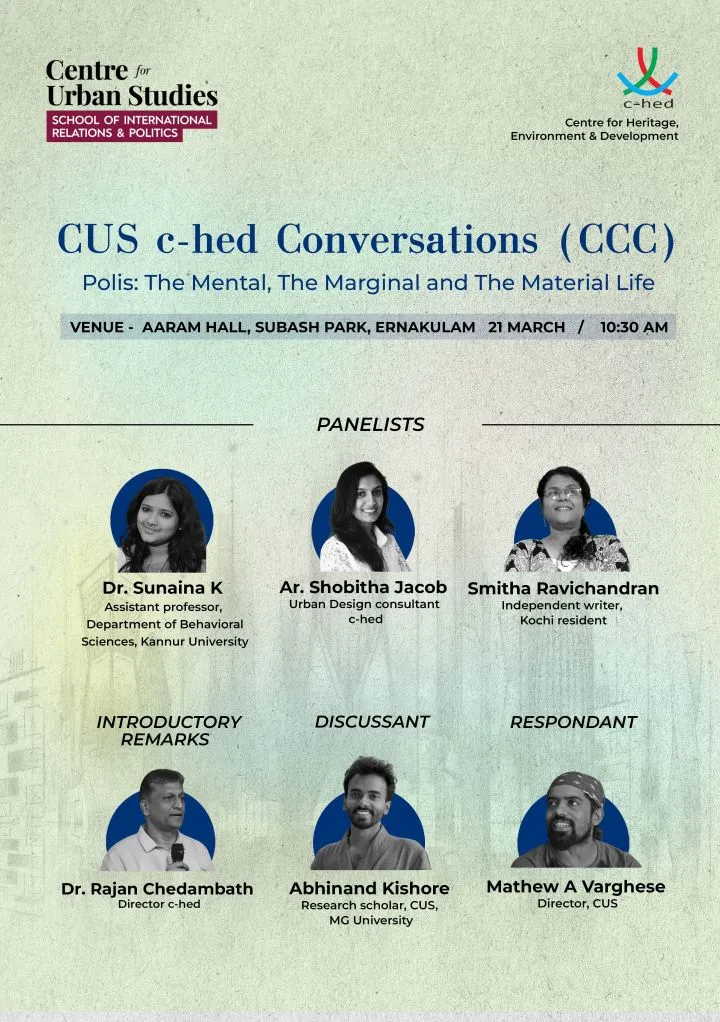
Dr. Rajan Chedambath, Director of c-hed, introduced the session by outlining the conceptual framework of the discussion. He highlighted the importance of examining the interwoven layers of urban existence — the psychological, the physical, and the socially peripheral — and urged participants to reflect on how these dimensions shape the lived experience of the city.
Dr. Sunaina K, Faculty at the Department of Behavioural Sciences, Kannur University, addressed the theme of urban mentalities. Her intervention examined how perceptions, behaviours, and collective consciousness influence and are influenced by urban environments. She noted that the mental landscape of a city significantly determines how spaces are navigated, interpreted, and inhabited.
Ar. Shobitha Jacob, Urban Design Consultant at c-hed, engaged with the material dimension of the city. She discussed how urban materialities resist rigid binaries and instead manifest through complex interplays of the living and non-living, human and non-human, concrete and subtle elements. Her presentation emphasized that material structures shape spatial realities while simultaneously being shaped by social processes.
Smitha Ravichandran, independent writer and city resident, focused on marginalities within urban contexts. She foregrounded socially and spatially marginal spaces and communities that often remain invisible in mainstream urban discourse. Her reflections highlighted how these marginal conditions are not peripheral but formative, sensorial and therefore must be brought to the forefront in all their complexities.
The panellists collectively underscored that the themes of Mental, Material, and Marginal are not watertight categories. Rather, the discussion sought to tease out their dialectical relationships and mutual entanglements within urban life.
Abhinand Kishore, Research Scholar with CUS, served as the discussant, synthesizing the key ideas emerging from the panel and posing critical questions that deepened the dialogue. Dr. Mathew A. Varghese, Director, CUS, responded briefly to the themes fore-fronted by the panellists and the interactions, reflecting on the theoretical and practical implications of the discussion for urban research and policy.
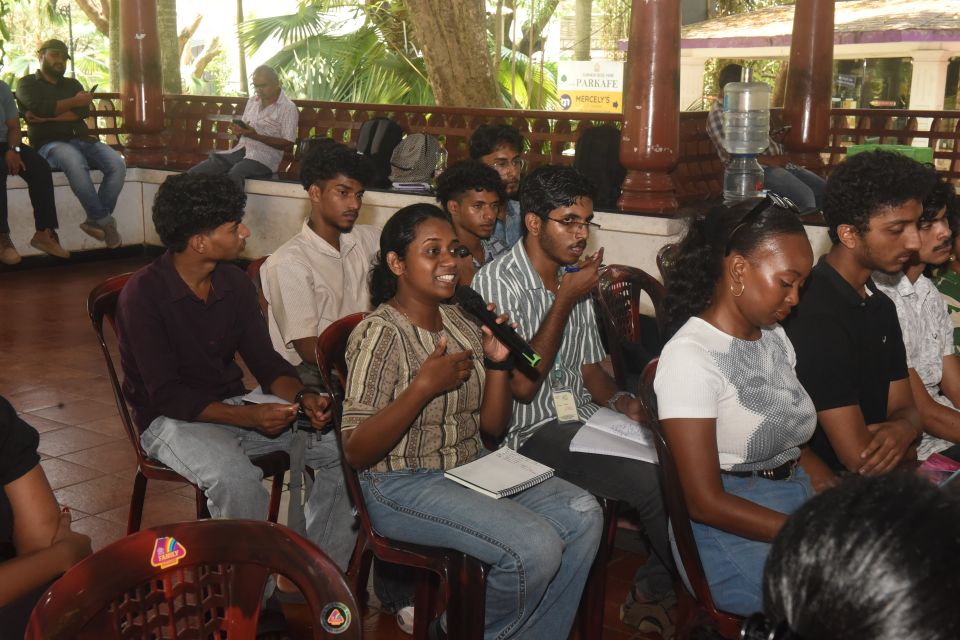
An interactive session followed, during which participants engaged the speakers with questions and reflections, extending the conversation into lived experiences and academic inquiry. The event successfully created a platform for scholars, dwellers, and participants to collectively reflect on the complexities of urban existence.
The discussion concluded with a renewed emphasis on the need to foreground the Mental, Material, and Marginal dimensions in future urban conversations, research, and planning practices.